Showing posts with label Europe. Show all posts

Saturday, 26 April 2014

An Academic Pilgrimage

Göttingen. It is a small town in the heart of Germany, with several lines of farms and a few small industries. But very few other places in the world have been home to such a stellar population. Many great personalities have been associated with The Georg-August University of Göttingen such as the Brothers Grimm, Heinrich Heine and Otto von Bismarck. The University was founded in 1737 by King George II of Great Britain (who was also the Elector of Hanover) and so far, 45 Nobel Laureates have studied, taught or worked at the University. (And of course, there have been many great Scientists who have graced the town in the pre-Nobel era. Giving Nobel or Fields medal to the likes of Gauss and Riemann would be an insult). 

So when I was visiting my friends there for Easter, we decided to pay homage to the giants of academia that have graced the land of Göttingen.


House of Richard Courant (Mathematician):


House of Hermann Weyl (Mathematician and Theoretical Physicist):


House of Edmund Landau (Mathematician):


House of Carl Ludwig Siegel (Mathematician):


House of Hermann Minkowski (Mathematician):


House of Carld Freidrich Gauss (Mathematician & Physicist):


House of Ezequiel Uricoechea (Chemist, Linguist and Polymath):


The statue of Wilhelm Weber (Physicist) and Carl Freidrich Gauss:


Statue of Freidrich Wöhler (Chemist):


Tomb of Carl Freidrich Gauss:


House of Walther Nernst (Physical Chemist & Physicist)


The Institute of Theoretical Physics (Old Building):

Max Born was the head of the department

Victor Weisskoff (Physicist):


and Carl Freidrich von Weizsäcker


Werner Heisenberg and Wolfgang Pauli also worked here for some time.


House of Max von Laue (Physicist):


House of Emmy Noether (Mathematician and Theoretical Physicist):
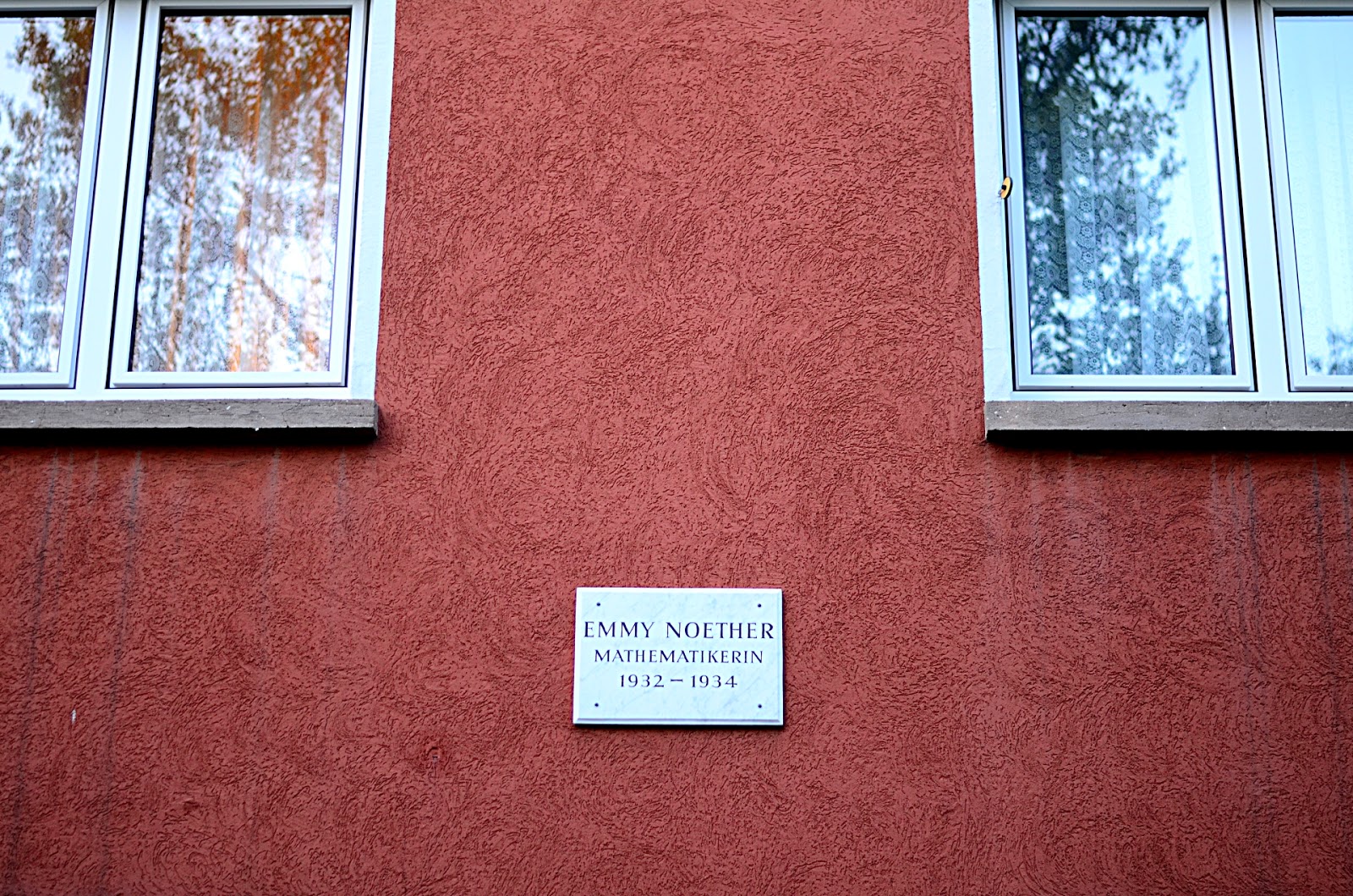


House of Bernhard Riemann (Mathematician):


Sunday, 2 June 2013

On A Bright Sunny Day, I Went On An Adventure


 In a hole in the ground, there lived a hobbit. 


 Bored with the routine of the life, he decided to go on an adventure
Off in the hills, in the woods he went.


Far away, a house on the hill caught his eye, to where he decided to go.


The road took him around the grasslands where sometimes he would catch a glimpse of the old times...


...and occasionally make some new friends.


Finally when he reached to the top, he was greeted by the splendid panoramic view of the Rhineland.


And met an old friend


Unsatisfied with the small hike, he decided to carry on.


A quick check for the directions, looking for options...


The signs of human invasion in the wilderness were found everywhere.


Finally, satisfied with the day's little adventure, he decided to treat himself with nice dessert and drinks.


...and returned home a very happy hobbit.


Monday, 25 March 2013

Applying for Ph.D. in Europe


Recently many people have asked me about the application procedure for Ph.D. in Germany, and answering the same questions to everybody individually is a pain, so I have decided to write this post about a general application procedure for PhD in Germany (or Europe in general).

Selecting the topic: The first and most important step is to decide which topic you want to work on. If you are unsure of the topic, then you can go through profiles of some researchers to know what they are working on and which topics might interest you. You can also talk to your professors, advisers or colleagues about the topic that you may want to work on. The topic should be scientifically important and feasible in the given time frame and budget. Once you have decided the topic(s), you can start the planning for applications.

Application Procedure: There are usually two ways to apply for a position. The traditional method is to look at the profiles of different researchers and see who is working on the topics you are interested in, and approaching them for a PhD position. You can email them stating your interest in working on the topic with him/her. If they have an open position, they will inform you about the detailed application procedure. Having a one-to-one conversation with them will be helpful in understanding (a) what your thoughts are about the topic and (b) what do they expect from you.

The second way is to apply to some graduate schools or research schools or standard application procedures of certain institutes or via some scholarship programs such as DAAD or Erasmus Mundus etc.. This method is helpful because most of these schools have a fixed budget which is independent of the budget of the researchers. Also due to standard procedures, you don't have to contact each and every person at that institute individually.

To have better chances at selection, it is advised to follow both the paths.

The application usually requires you to submit following documents:

  1. A brief, concise curriculum vitae. The CV should contain objective information about your academic career, such as your grades at undergraduate and masters level, performance at entrance/qualification examinations, publications, projects you have worked on, schools & conferences attended and co-curricular activities.

  1. Statement of Purpose: In this statement, you are expected to describe your broad aims during your Ph.D., why you are applying at that place, what are your expectations, and how will the institute benefit from you. It can also be used to assert certain qualities about you which are not stated in your CV. (This is similar to the statement you have to submit when you apply to Universities in USA.)

  1. Research interest: Along with the application, you have to submit your research interest wherein you have to explain which topic you want to work on, why are you interested in that topic, and what are your ideas or inputs you have on that topic.

  1. Letters of recommendation: Usually you have to submit at least 2 letters of recommendation from people who know you well, for example, someone who has guided you during a project, or a person who has taught you courses at bachelor's or master's level.

These are the documents that you would require for application, although the particulars may differ from case to case. The whole procedure from deciding the topic till the successful submission of the application usually takes few months, so it's always good to start early!

Total Pageviews